Hatchery House
The Hatchery House property (4490 Hatchery Road) is located on the southwest corner of the southeast quarter of section 10, plat 24. This parcel of land was owned by Lewis L. Dunlap in 1864 and later sold to John Judd in 1872.
The Hatchery House is a Sterling Home, Senator, Model B, a popular pre-cut/mail-order home offered by the International Mill and Timber Company of Bay City between 1916 and 1922. Sterling Homes offered to customize the home to the owner specifications for a small charge. Ours differs slightly from the basic plan.
Architecturally, the house is known as a Four-Square (1905-1930), a style that was made popular directly and exclusively through the catalogs of Aladdin, Lewis-Liberty, Sterling, Sears, Montgomery Ward and numerous smaller manufacturers. The Four-Square is the easiest of American architectural styles to identify because it has one standardized form. They are simple two-story structures, square or rectangular in plan, without complementing wings or additions. The hip roof is a required feature of the style, typically punctured by a dormer window. The front porch is also a requirement of the style and usually extends the full width of the facade.
The Four-Square was a particularly popular model as many variations could be made to make the style economical with significant savings. The Hatchery House follows the rustic views of the Arts and Crafts Movement (1905-1920). The Great Depression stifled popularity of the style and it is only recently that the Four-Square has been accepted as a recognized architectural style. Our Hatchery House is the only Senator B that the Bay City Historical Society is aware of with the original floor plan.
The House a Bass Station Built
Before the Hatchery House was built on this location, the property was owned by the Michigan State Fish Commission. The fish hatchery was opened by the state on the property in 1903 as the Drayton Plains Station. It was built as an additional site to raise bass fingerlings. When the state purchased it, there was a power dam, a mill building, a residence and 18 acres of land. The brick residence was across the wooden bridge and across Hatchery Road from the current Hatchery House. This was the home of the Mill operator of the original Drayton Mill built in 1835 and was now used for the overseer of the Drayton Plains Station. The mill building was the original 1835 grist mill and was located across the river from the current Hatchery House. The 18 acres included the present Drayton Plains Nature Center grounds.
Around 1917, a new overseer’s home was ordered to be built on higher ground. This was the present Hatchery House. The house was ordered as a kit from Sterling Homes in Bay City, Michigan. The kit was delivered to the Drayton Plains Depot and transported by horse and buggy down the road to the current site. The kit house was assembled by the prisoners from Camp Pontiac. It was originally painted two-tone gray and white, with black window sashes and cedar shingle roofing.
Although built complete with all its electrical wiring, the Hatchery House did not have working electricity until power lines came through the area in1921; kerosene lamps were used for the first two years of occupancy.
1921-1924: Mr. Harold Hughes, Assistant Manager of the Drayton Plains Station, moved in with his bride, Velma, a Waterford Township teacher. Velma painted fish on the kitchen cupboards and on the bathtub. She also painted “Cleanliness is next to Godliness” on the tub. She had organdy curtains tied back at all the windows and window boxes. In 1924, Harold was transferred to Grand Rapids and the Comstock Fish Station.
1924-1925: Seymour Bromer moved into the home for one year.
1925-1941: Superintendent A.T. Stewart and his wife Arletta, moved in. By this time, the old brick overseer’s home had been torn down and the Hatchery House Senator B was now the Superintendent’s home.
1941-1942: Nick O’Dea and his family moved in.
1942-1961: The Hughes came back to the Hatchery House. Harold was then the Superintendent of the Drayton Plains Fish Hatchery. They lived there until 1961 when Hughes retired.
1962: Operations at the Drayton Plains Fish Hatchery ended for good.
1964 or so: The newly formed Drayton Plains Nature Center, Inc., purchased the land minus the four acres of the current Fish Hatchery Park.
1962-1972: This four acre parcel of land, including the Hatchery House and buildings, was still owned by the State of Michigan. Mr. Cliff Fuller of the Department of Natural Resources lived in the Hatchery House at this time.
1972- 1981: Mr. And Mrs. Chuck and Helen Welsh and children moved into the home.
1981-1991: The Michigan Department of Transportation used the Hatchery House for a field office.
1991 to present: The Waterford Parks and Recreation Department purchased the four acres and the Hatchery House from the State of Michigan for one dollar. Four more acres to the west were immediately acquired, and the total eight acres was turned into Fish Hatchery Park.
1992 to present: The Hatchery House was vacant until the first part of 1992 when it was offered to the Waterford Historical Society to be used for their headquarters. The Historical Society renovated the inside and Parks and Recreation took care of the outside. The first meeting was held in the house in May 1992.
The Drayton Plains State Fish Hatchery
Starting around 1913, the Drayton Plains Station began to be called the “Drayton Plains Hatchery”. By 1934, the name was officially changed to “The Drayton Plains State Fish Hatchery”, and remained thus until closing in 1962.
Many improvements to the buildings and grounds had been made along the way.
1904-1905: construction of ponds and their connections, grading, repairs to dam and buildings and rearranging land to conform to the needs of the Fish Station was done. A boat house was built (and still exists today behind the Fire Station on our grounds). The original Mill building was moved across the river to sit next to the boathouse and was then used as the Bass Station’s main building.
1905-1906: Additional rearing ponds constructed.
1907-1908: Fencing installed, trees planted, new horse barn constructed, gravel drives and more ponds constructed.
1935-1940: A complete modernization and enlargement of the Fish Hatchery took place, with many of the older original buildings being torn down. Over 300,000 yards of dirt were removed, 5500 feet of water supply pipe were laid, and 2600 feet of graveled roadway were constructed. The total area of the hatchery grounds is 87 acres, of which 47 acres are in ponds. The Station now had eleven rearing ponds, 10 experimental ponds, six exhibition ponds, hatchery building, garage, workshop, superintendent’s residence, and foreman’s residence.
1962: Operations at the Drayton Plains Fish Hatchery ended.
Log Cabin
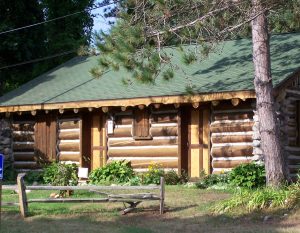
The Log Cabin on our site was originally on the north side of Dixie Highway across from where Andersonville Road ends. Lots 3, 4 and 5, on which the cabin sat, was part of the land granted to Alpheus Williams by the United States government. This transaction was recorded in 1825 as being the northwest quarter of Section 4, Town 3 north, Range 9 east, 161.40 acres in the County of Oakland and the Territory of Michigan.
The above lots were included in the sale from Fredrich Steevins to Horace Steevins in 1842. Horace Steevins then sold the lots to William Windiate in 1844.
In 1845, the area was platted and called the Windiate Addition. Elizabeth Windiate inherited the lots in 1845 upon her husband’s death. In 1915, a strip of land 66′ wide was taken by the State for the Saginaw Turnpike (Dixie Highway). The land was clear of all mortgages in 1922. That is the last entry in the Abstract of the Windiate Addition about these lots.
Mr. And Mrs. George and Agnes Flickinger had the log cabin built by Jim Stites in the early 1930s. They rented the cabin out as a gas station in 1934. It was then sold to Mr. And Mrs. Robert and Edith Bliss.
It was a Variety Store which sold children’s clothes, yard goods, needles, thread, buttons, etc.
In the late 50’s, early 60’s it was owned by Florence and George Engel.
Following that it was a sign shop owned by Howard Husted. We do not know when Mr. Husted left.
In 1991, Mr. Victor Gerhardt purchased the land. The store was vacant. A grant from the C.D.G.B. was researched by Bob Vallina, Director of Community Planning and Development. He received the grant and it was passed by the Waterford Township Board in March, 1994. The grant money was to move and to cover only the restoration of the outside of the cabin. The Historical Society finished the inside from donated funds.
The land at the Hatchery House site, where the log cabin now sits, was prepared for the foundation during the last week in August, 1994. The cabin was moved September 30, 1994. Restoration was started in March 6, 1995 with an expected completion date of May 31, 1995 but due to weather conditions, it was not completed until July 1995. The Log Cabin was dedicated on July 30, 1995. On June 29, 1996 the American Flag was flown over the Log Cabin for the first time.
Blain Playhouse
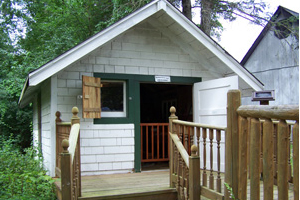
The Blain Playhouse was built in the early 1930s by Doctor Alexander Blain II, founder of the Blain Memorial Hospital in Detroit. Dr. Blain first built a playhouse for his daughter, Shirley. His sons, Alexander III and Donald were upset and so a “boy’s playhouse” was built. We have the boy’s playhouse.
In 1947, Dr. Blain gave the playhouse to Vernon Price, who had worked part-time on the island since 1938, for his daughter Dorothy. The playhouse was loaded on a flatbed and taken over the log bridge off the island and transported to 5390 Elizabeth Lake Road.
The playhouse remained there until the mid-1960s when it was given to John and Vivian Borkowski. John Borkowski and Ray Lalone rolled the playhouse on well-drilling pipes up the hill from where it had been since 1947 to 5350 Elizabeth Lake Road, residence of John and Vivian Borkowski.
In December 1997, the playhouse was donated to the Waterford Historical Society by Vivian Borkowski. It was again loaded on a flatbed and moved to 4490 Hatchery Road, home of the society. It is currently a museum for antique toys.
School House & Outhouse
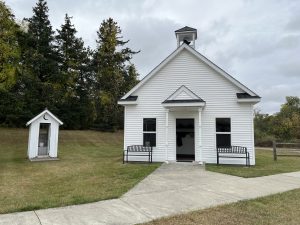
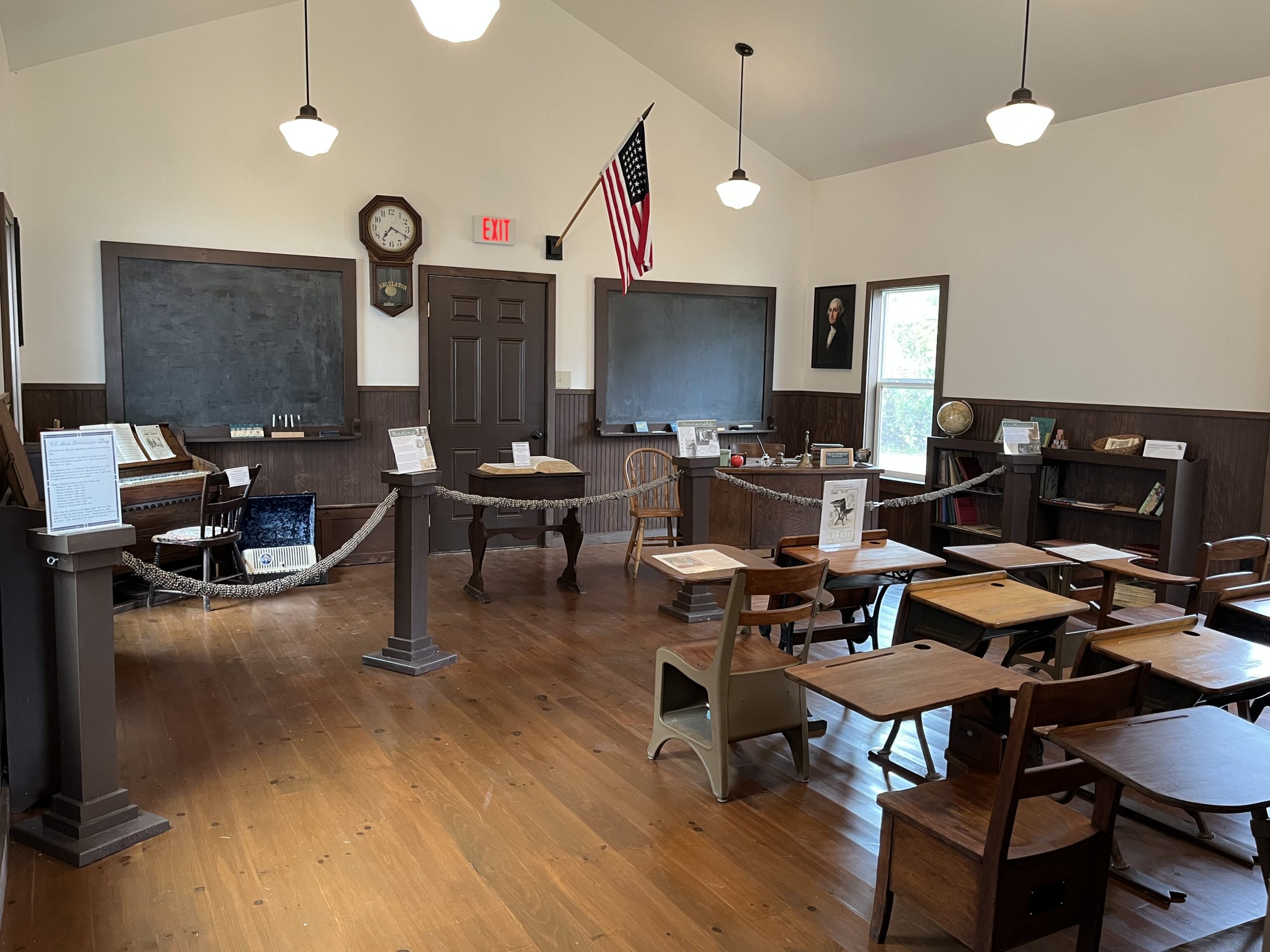
Built on site in 2014, our schoolhouse is one-room and represents the eleven one-room schoolhouses in early Waterford.
A one-room schoolhouse was literally one room where all ages and grade levels were taught together. School was centered on the “Three R’s”, Reading, ‘Riting (writing) and ‘Rithmetic (arithmetic). To help the teacher, older students would help younger students with their lessons.
The schoolhouse served other community functions. Social and holiday gatherings, box socials, spelling bees, singing bees and even church services were also held in the schoolhouse.
Education was extremely important to the early Waterford pioneers. Schools were built one by one as the population increased. In the fall of 1821, the first school classes in Oakland County were held in Oliver Williams’ sheep barn on Silver Lake. Seven students attended class. The first schoolhouse was made of logs and erected on that same property in 1822 for twelve students. Ira Donelson was named the first Supervisor of Education in 1835.
Outhouse
Our outhouse was donated by the Waterford Fire Department and came from property on Crescent Lake Road. Before indoor plumbing existed, the outhouse was part of normal everyday life. As toilet paper was a luxury, old Montgomery Ward or Sears catalogs were used and were also handy for reading material. Ours is a two-seater.
Carriage House & Blacksmith
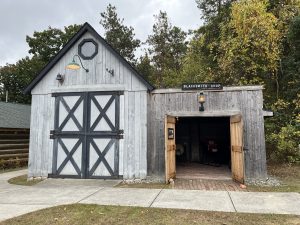
Carriage houses were common before automobiles as a place to store a horse-drawn carriage and all the necessary tack. Our carriage house is currently being used for storage and a workshop.
Blacksmith
Attached to the Carriage House, the Blacksmith Shop is the newest building in our Village.
A blacksmith is one of the most important people in a town. Blacksmiths create objects from iron or steel. Think of the many metal items pioneers would use: farm tools, rims and parts for wagons and carriages, nails, fireplace racks and tools, locks, door handles, pots, utensils, and of course, horseshoes.
According to the History of Oakland County, 1877, by Samuel Durant, blacksmithing was done prior to 1840 by Henry S. Andrews, who opened the first blacksmith shop in the Village of Waterford. He manufactured and fitted much of the iron work in the grist mill.
Jacober’s General Store
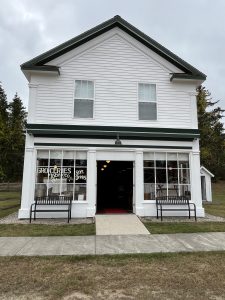
Jacober’s Store was built in 1856 by Horace Huntoon and John Griffen on the southeast corner of Dixie Highway and Andersonville Road. It was owned by Phineas Huntoon from 1860 – 1903. The store was idle for a few years but the second floor was used as a justice court, and a dance hall.
August Jacober purchased the store in 1917 and ran it until Henry Ford purchased it for $700.00 in 1927. Henry Ford had it moved to Greenfield Village where it still stands with the name of J.R. Jones, one of the owners at the turn of the century.
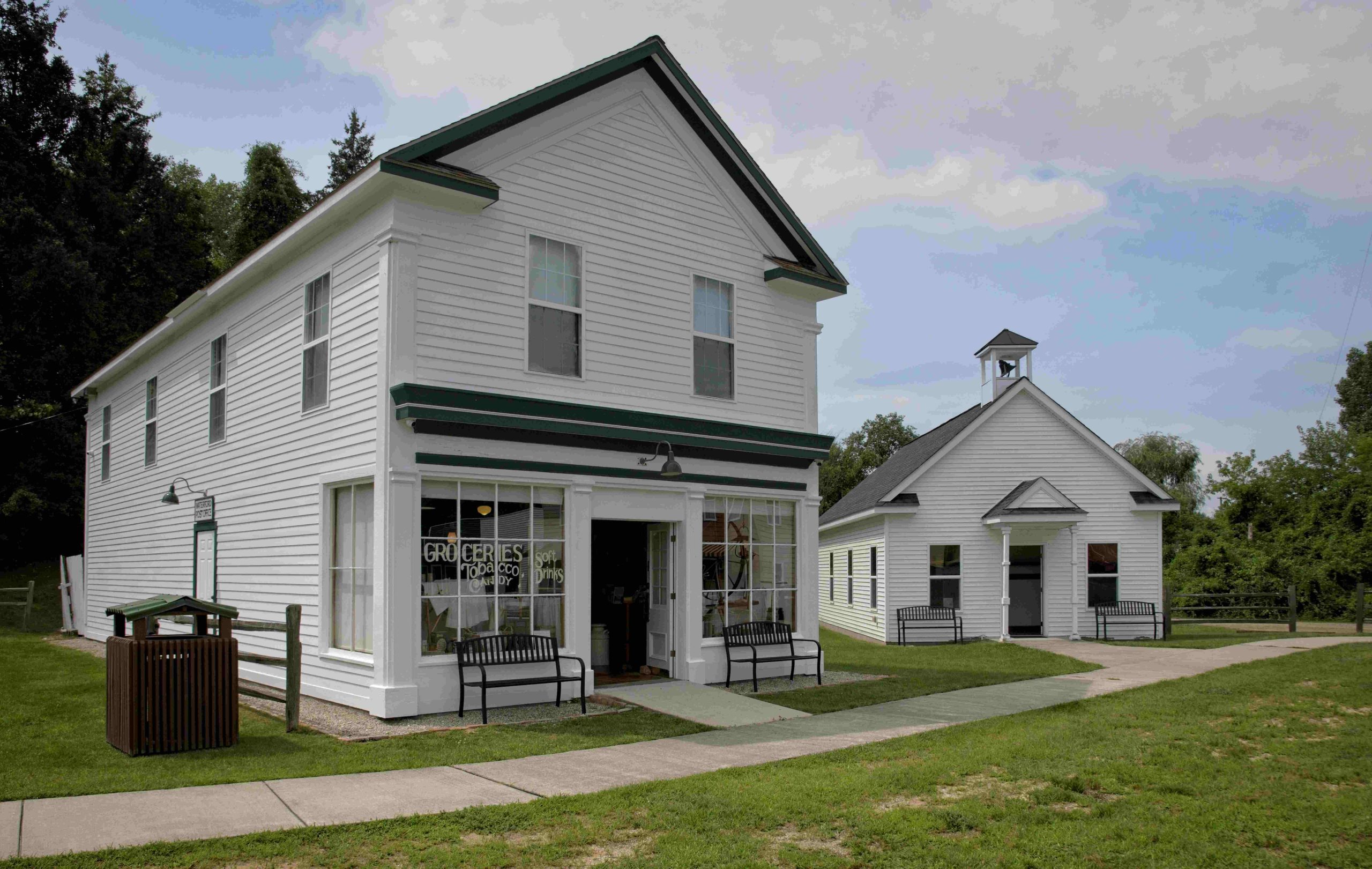
August Jacober built another store in the same location and ran it until 1957 when he sold it to the Community National Bank. Construction of a replica of Jacober’s Store was begun in 2001 at our site in Fish Hatchery Park in Historic Waterford Village. Our store is a representation of the early 1900s and is called Jacober’s Store after August Jacober.
Nelson’s Filling Station
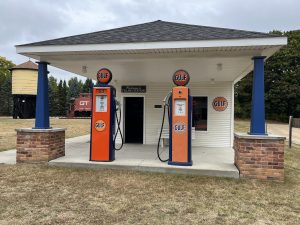
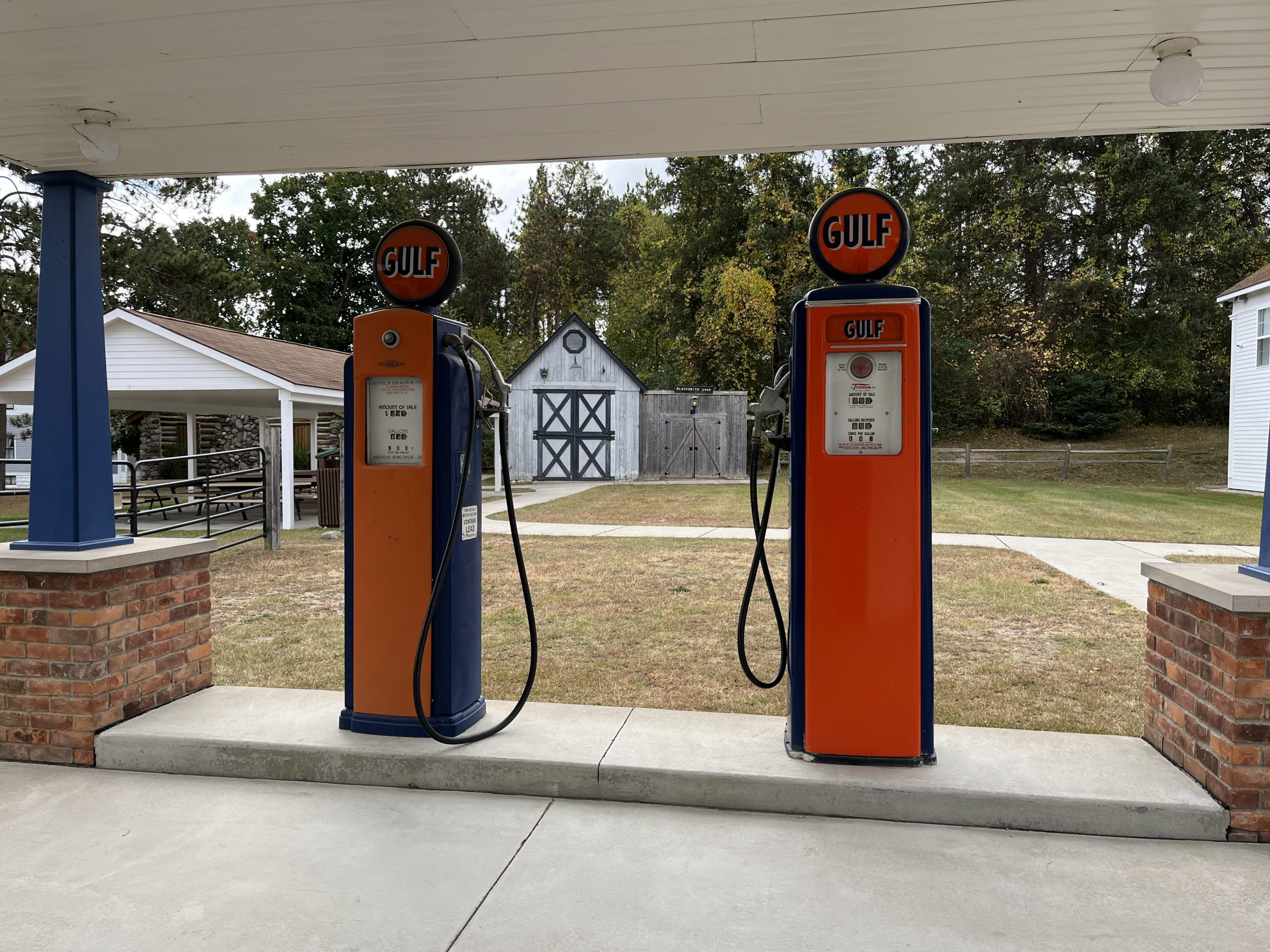
Our Station represents the early 1920s when automobiles began replacing horse and buggy as the preferred mode of transportation.
Automobiles required gasoline. At first, motorists had to buy their gas in cans from general stores. Next came hand pumps in tanks at the curbside in front of these stores. Congestion ensued with many accidents taking place because the General Stores were sitting so close to the roadway.
To fix this problem, small buildings were built just to sell gas. These were called filling stations. These stations had dedicated areas where a customer had room to pull up next to the pump in a safer manner.
Next, service areas were added to these buildings and became full-service gas stations. Starting in 1982, self-serve stations became the norm.
Completed in 2011, our Filling Station was entirely funded by member Robert Nelson.
Cobbler
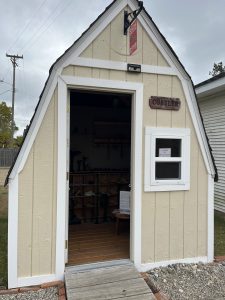
This shop was the Eagle Scout project of Brad O’Connor, Boy Scout Troop 51, in Waterford. In June 2014, this storage shed was moved from next to our Carriage House to its present location between the Print Shop and Nelson’s Filling Station. It was turned around, outfitted and repurposed into a Cobbler Shop.
Shoemakers or Cobblers were important to early towns. Shoes were very expensive and not disposable. Cobblers repaired and made shoes out of old leather. Shoemakers repaired and made shoes out of new leather. This was before shoes were made on machines.
People wore their shoes for years, had them repaired and then passed them on to others. Children oftentimes went barefoot or only wore shoes to church. Rarely did they have a new pair.
Our shop represents the early 1800s Cobbler Shop that existed in the “downtown” area of Waterford at Andersonville Road & Dixie Highway.
Lohff Print Shop
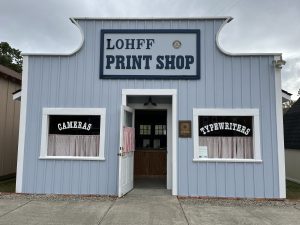
The Print Shop was built on our site in 2005, by the Waterford Rotary Club. The Print Shop contains a 1908 printing press and houses our collection of cameras, typewriters and various office machines of the past.
The Printing Press was donated by the Lohff family. The following is the history about the printing press written by Richard Lohff.
The press comes to us from the family of Theodore and Wilhelmina Lohff (Theo & Minnie). Theo purchased the press used, in 1908, while living in Abrams, Wisconsin. The press was “invented in China, redesigned, revised, but still set up one letter at a time”. This means the press had drawers of type. One piece of type for each letter and maybe 100 of each letter of the alphabet in maybe three sizes. Each sheet was fed into the press one at a time.
In 1908 Theo had leased a grocery store with an apartment upstairs and various out buildings. The lease for the store was $150.00 a year. That store was just replaced in 1996 with a new U.S. Post Office building.
The press was to be used to print all of his signs for the store to save money. As time went by, Theo found he liked the printing work better than the grocery business. Theo and his family moved to Iron River, Iron Mountain, Manistee, and finally settled in Pontiac around 1923. When the family moved so did the press. Copies of things found with the press indicate the press was used each place they lived. Theo also was an architect, land developer, carpenter and father of five. Theo and Minnie settled in Pontiac as did three of the children who stayed in the Pontiac area and eventually settled in Waterford.
One reason the press never left the family was that, during the great depression, the press was used to print ads for local businesses, which kept the family afloat. In 1941 Theo died. Around 1945 Minnie sold the home. Their son, Francis saved the press, saying it got the family through one depression and we may need it again.
Hardware Store
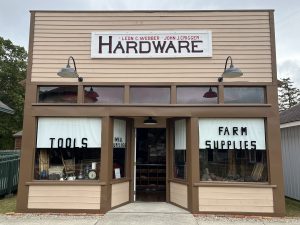
As people moved into early towns, saw mills sprang up to supply the various wood people needed to build their houses and barns. This led to a desire for more specialized tools to work with the wood. The need for these tools outgrew the space in the General Store and thus hardware stores came about.
This was how most specialty stores began, like clothing stores, millineries, book stores, and department stores. Having extensive knowledge and advice for the customer made these stores extremely popular, even today.
Hardware stores also carried sporting goods, crockery for housewives and toys for children.
Our Hardware Store is a representation of these early specialty stores. Built on our site in 2004, the funds for the Hardware store were donated by Dorothy Webber and named after her husband, Leon C. Webber and her father, John J. Crigger.
Drayton Plains Depot
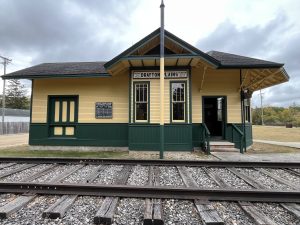
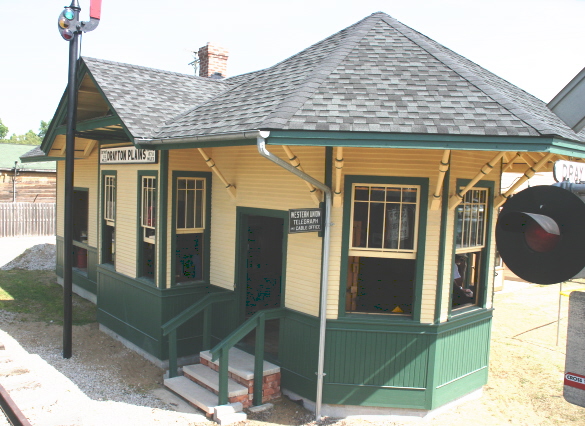
The original depot was built in 1908 by the Detroit Haven & Milwaukee Railway, a subsidiary of the Grand Trunk Railroad System. The building sat on the northeast corner of Hatchery Road and Saginaw Trail (Dixie) on the south side of the tracks. It was a Lake Victorian style-asymmetrical roof line, octagonal tower end design with turned decorative spindles. The building was 40 feet long, 12 feet wide and had overhands of 3 feet on the main building and 5 ½ feet on the waiting room.
In the early days, train travel was common and the Drayton Plains Depot bustled with daily activity. Many tourists came to Waterford from places like Detroit so they could vacation on the beautiful lakes during the hot summer.
Many students in Waterford would ride the train from the Drayton Plains Depot to Pontiac High School to finish grades 11 & 12. At that time, Waterford High School only went to 10th grade.
Blocks of ice cut from the Pittmans & Dean Ice House on Loon Lake were loaded on the train at the Depot and shipped all over the United States.
The Michigan Department of Conservation shipped live fish, raised at the Drayton Plains Fish Hatchery, to points throughout the state of Michigan.
The depot was closed in 1957, declared an “eyesore” in 1964, and was demolished in 1965. The only thing left was the sign.
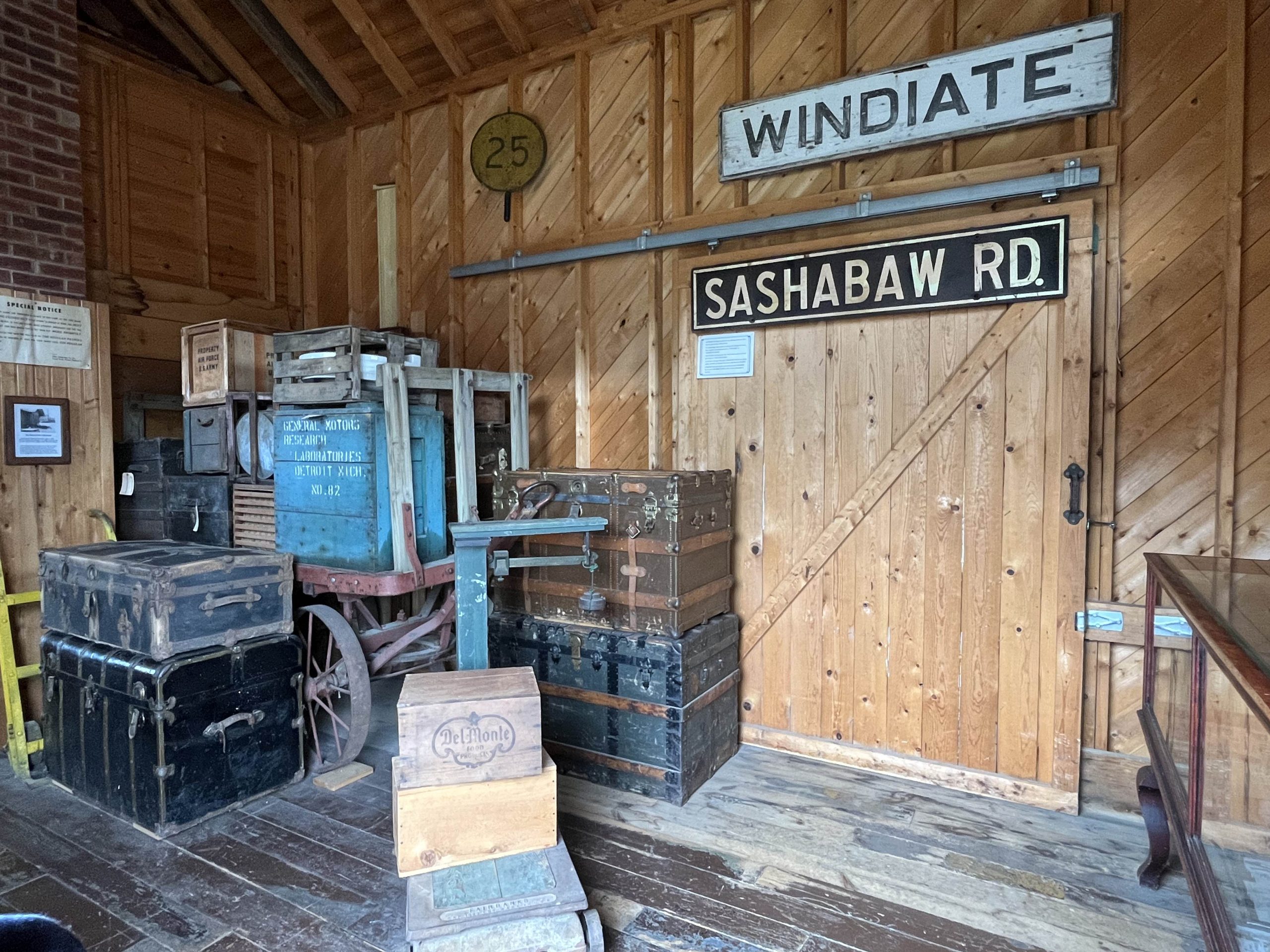
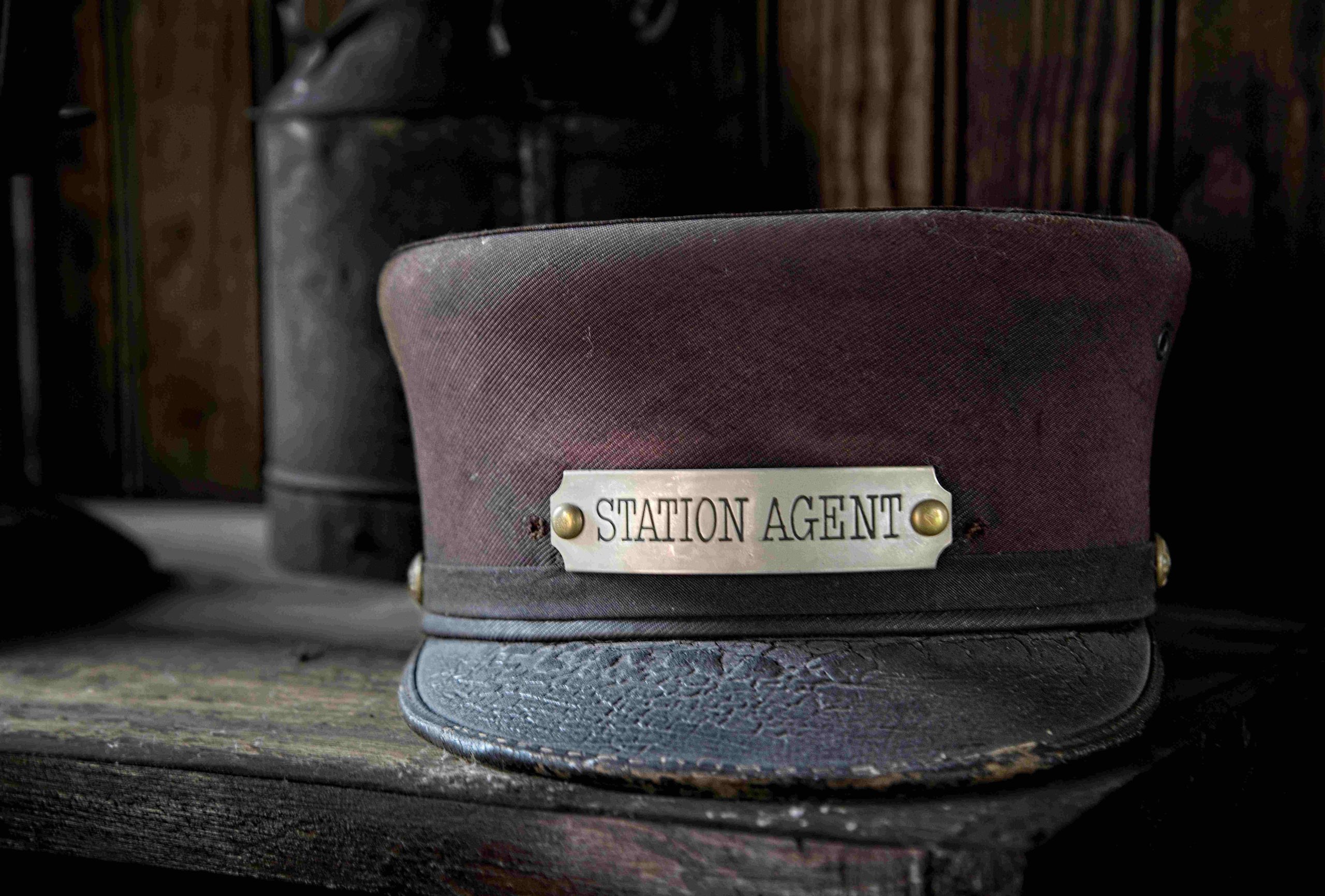
In 1995-1996, an exact replica of the original Drayton Plains Depot was built by Richard Welsh, on his property in Holly, Michigan. The Depot was donated and moved to our grounds in September of 2001, effectively bringing the Depot “home” only a quarter of a mile away from its original location. Currently the interior of the Depot is restored as if the conductor just stepped out to check on the next train to Pontiac.
Grand Trunk Caboose
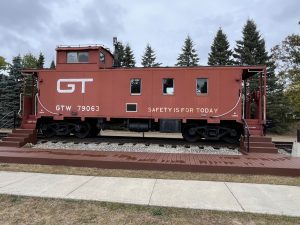
The Railroad came to Waterford in 1852, bringing tourists, settlers and all kinds of freight into town. The Railroad also carried Waterford freight, like ice and apples, across the country.
Our 1957 Grand Trunk Caboose arrived on site in 1999, and is a 28-ton, 40-foot reminder of the past. Though not as old as those first Caboose arriving into town, our Caboose still represents that early time in railroad history.
The caboose was at the end of a train. It functioned as an office for the conductor and a home away from home for the trainmen and crew consisting of the brakeman and flagman. They would cook their meals, eat, sleep, relax and decorate with homey touches like curtains and family photos.
Once under way, the trainmen would sit up in the cupola and watch for smoke or other signs of trouble from overheated wheel journals (called hotboxes).
Eventually, technology, like automatic airbrakes and then computers, put the caboose out of business. Since 1984, “end of train” or EOT devices have been used on trains. These small metal remote radio devices hang on the last car and take the place of every function the caboose used to do.
In years to come, the only caboose you see will be the ones that have been restored. They are considered obsolete.
Watchpocket Building
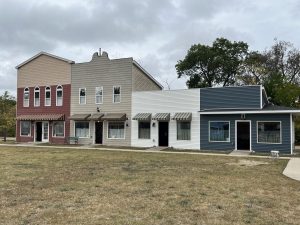
The Watchpocket Building and Bakery are named after the Ellsworth Watchpocket Family. A bakery in the early 1900s served the same function as today, to provide fresh baked bread, pastries, cookies, cakes and pies to the public. Some Bakeries branched out into candies and would install a soda or ice cream fountain.
Marge & Irene’s Millinery is named after the mothers of The Dick & Carol LeMarbe Family. Millineries, most often owned by women, carried all types of lady’s hats, gloves and accessories. Many of these shops would also carry clothing or have the ability to custom make clothing for women. This was one of a few well-respected professions for women in the early 1900s.
The Village Barber Shop is a one chair shop. An early 1900s Barber shop functioned, not only as a place to groom the men in a town, but also as a popular center for daily news and gossip. Our circa 1880 barber chair was donated to us for our shop by the White Lake Historical Society.
The Doctor’s Office represents a typical town doctor of the early 1900s. Cramped and simply furnished, the doctor’s office was a no-frills place with very little privacy. This was a time when the medical field was just discovering the importance of germs, hand washing and sterilization.
The Dentist’s Office also represents an early time in dentistry. In 1937, Dr. J. Keith Schachern purchased the dentist chair from Ransom & Randolph in Detroit, to start his practice at 28 ½ West Huron Street in downtown Pontiac. Much like the doctor, early dentistry was painful business and most folks simply chose not to go.
The Hands-On History area is in the north end of the Watchpocket Building and functions as an area where our visitors can touch the past. In this area you will find books, dolls, games and toys. Please feel free to grab a slate and chalk and sit at a school desk to complete your penmanship or arithmetic exercises. Write on our full-size chalkboard and try your hand at our artifact challenge. Play a game of checkers or build with Lincoln Logs.
This section of the Watchpocket building was constructed in part with funds presented in March 2012, to the Historical Society by Paige Daniel as part of her State President project for the Michigan Society, Children of the American Revolution.
Fire Station
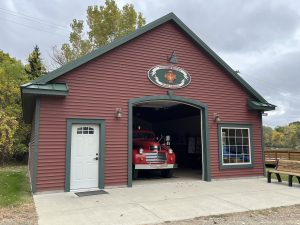
The Fire Station tells the rich history of the Waterford Township Fire Department through an extensive collection of artifacts, photographs and displays.
Built in 2018, the Fire Station was funded by the Waterford Township Volunteer Fire Fighters Association. Many community members volunteered countless hours and resources to this project. The organization also owns, staffs and maintains the building.
The gem of the collection is the 1941 GMC American Fire Engine. This is the first Fire truck in Waterford Township. The truck has a 500 gallon per minute pump and a 500-gallon water tank. Purchased December 5, 1941, for a cost of $5919.50, the truck remained in service until 1969. The truck still runs and participates in many local parades.